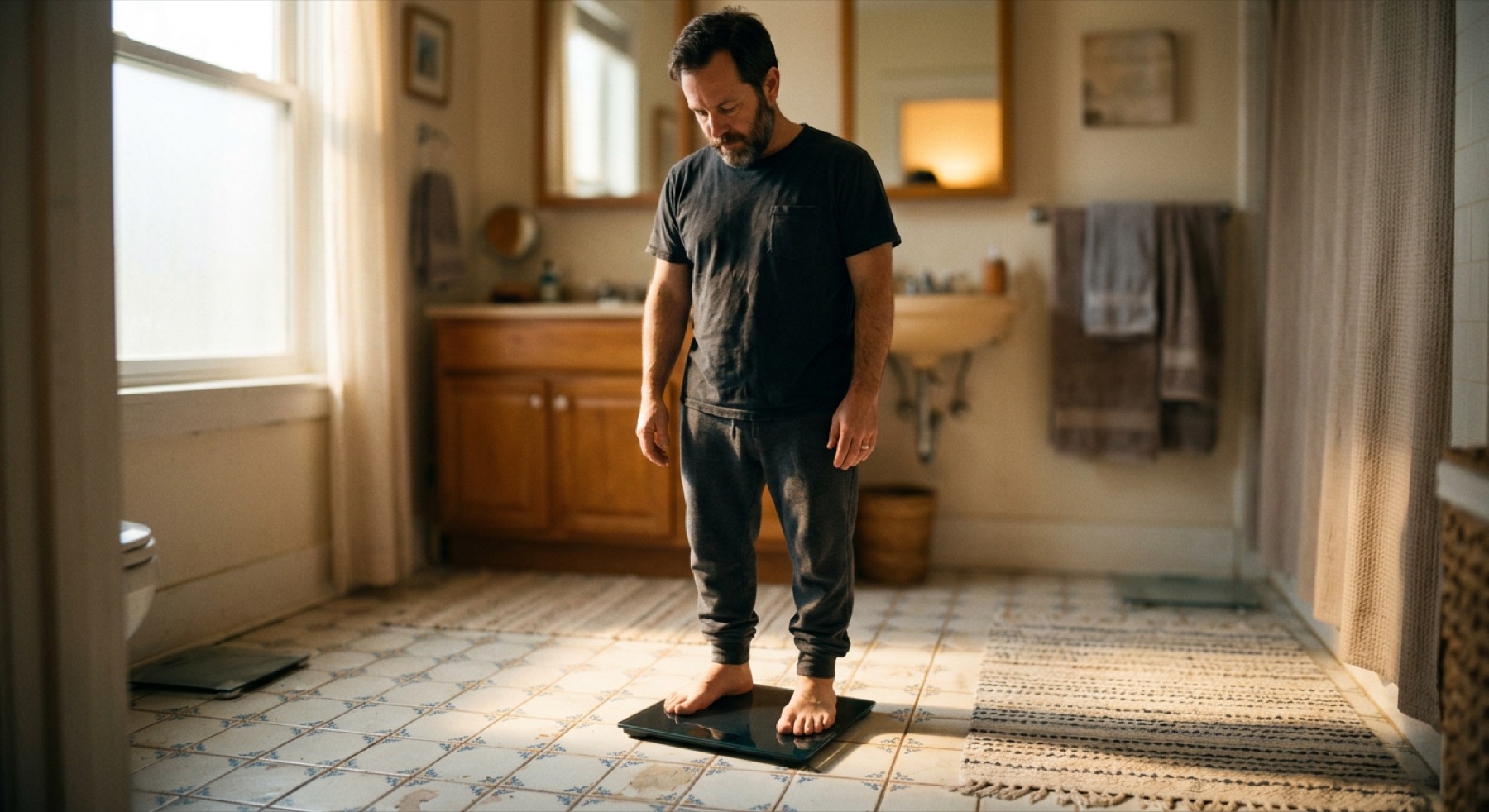
How I Actually Lost 30 Pounds Without Dieting (And Kept It Off)
The funniest part about "dieting" is it usually makes you think about food more.
Every diet I tried before this turned food into a math problem. Count the calories. Weigh the chicken. Measure the rice. Log it in an app. Feel guilty when you don't.
And here's what happened every single time: I'd be disciplined for 2-3 weeks, lose some weight, hit a wall, get tired of the constant food math, stop tracking, eat everything in sight for a weekend, and then spend Monday morning wondering what was wrong with me.
Nothing was wrong with me. The system was wrong.
I didn't lose 30 pounds by finding a better diet. I lost them by building a system that could survive my actual life — the travel, the stress, the kids, the late nights, the dinners out, the days where I had zero willpower and didn't care.
This is that story.
The Loop I Was Stuck In
I'm guessing you know this loop because almost everyone does.
Step 1: get motivated (usually on a sunday night or january 1st).
Step 2: go all-in on some restrictive plan.
Step 3: feel great for 10 days because the novelty is fueling you.
Step 4: hit a hard day — bad sleep, work stress, kids going crazy.
Step 5: eat something "off plan" and feel like you blew it.
Step 6: since you already blew it, might as well eat whatever for the rest of the day.
Step 7: wake up bloated and ashamed.
Step 8: tell yourself you'll start fresh on monday.
Repeat until you stop trying.
I ran this loop for years. And the thing that finally broke it was realizing I was treating fat loss like a project with a start and end date, when it's actually a lifestyle shift that has to feel easy enough to keep doing when life gets hard.
The Shift That Actually Worked
I stopped asking "what should I eat?" And started asking "what system can I repeat when I'm tired, stressed, and don't feel like trying?"
That question changed everything.
Because the answer ruled out 90% of diets immediately. Anything that required:
- Daily tracking
- Eliminating entire food groups permanently
- Cooking every meal from scratch
- Willpower as the primary mechanism
... Was dead on arrival. All of those break the moment life gets real.
What survived that filter was surprisingly simple:
1. Anchor every meal with protein.
This is the single biggest change I made. When protein is the center of every meal, everything else falls into place. You're less hungry. You hold onto muscle. You stop snacking because you're actually full.
I didn't need an app for this. I just asked myself one question before every meal: "where's the protein?" If I couldn't answer it, I adjusted.
2. Stop eating carbs by accident.
I didn't go keto. I didn't cut carbs completely. I just stopped eating them mindlessly — the bread basket, the chips with the sandwich, the cereal at 10pm, the granola bar because I was bored.
When I ate carbs, I ate them on purpose: around training, or at dinner, or at a social event where I wanted to enjoy the food.
This is what I eventually turned into the carb fasting framework. The full guide is Here if you want the protocol.
3. Lift weights 3x a week. Walk every day.
This was non-negotiable. I didn't do anything complicated — 3 full-body sessions a week, 45 minutes each, and I walked 7,000-10,000 steps a day.
The lifting preserved muscle while I lost fat. The walking burned calories without spiking my appetite. Together they changed my body composition faster than any amount of cardio ever did.
4. Sleep like it matters (because it does).
I was sleeping 5-6 hours a night and wondering why I was always hungry and couldn't stick to anything.
Turns out, sleep deprivation increases ghrelin (the hunger hormone), decreases leptin (the satiety hormone), and makes you crave carbs and sugar like your body depends on it. Because in that state, it kind of does.
I made 7+ hours non-negotiable. That alone reduced my cravings by probably 40%.
5. Build in grace, not perfection.
I gave myself permission to eat off-plan without guilt. A dinner out with friends wasn't a "cheat meal" — it was tuesday night. A slice of birthday cake wasn't a failure — it was cake.
The rule was simple: if I ate something unplanned, the next meal was back to protein + low-carb. No spiraling. No "start over monday." Just the next meal.
This is the part most diet advice gets completely wrong. They build systems that require perfection and then act surprised when imperfect humans can't sustain them.
What the First Month Looked Like
Week 1: I swapped breakfast from cereal to eggs. I stopped buying chips. I started walking after dinner instead of watching tv. I lost 4 pounds (mostly water, but it felt great).
Week 2: I started lifting. Three sessions that week. I meal-prepped protein for lunches — grilled chicken, ground turkey, hard boiled eggs. Nothing fancy. I lost 2 more pounds.
Week 3: this was the hard one. Work got intense. I ate pizza one night, had beers another night, and felt like I was sliding. But instead of spiraling, I just went back to the rules the next meal. I lost 1 pound.
Week 4: something clicked. I stopped thinking about it so much. Protein first was automatic. Walking was automatic. Lifting was something I looked forward to. The system was running on its own. I lost 2 more pounds.
Total after 4 weeks: 9 pounds down. 21 to go. But the difference was I didn't feel like I was dying.
The Next 5 Months (Where the Real Change Happened)
Months 2-6 weren't dramatic. They were boring. And that's the point.
I kept doing the same things:
- Protein at every meal
- Carbs only on purpose
- Lift 3x, walk daily
- Sleep 7+ hours
- Next-meal mentality when I ate off-plan
I averaged about 1-1.5 pounds per week. Some weeks I lost nothing. One week I gained 3 pounds because I went on vacation and ate everything. The following week I lost 4 because my body corrected itself once I went back to the routine.
By month 6, I was down 30 pounds. But the number on the scale was honestly the least interesting part.
What changed:
- My energy was consistent all day. No more 2pm crash.
- I could go 5-6 hours between meals without getting shaky or irritable.
- My lifts went up even as my weight went down (that's the muscle preservation effect).
- I slept deeper and woke up without an alarm.
- I stopped thinking about food all the time. It went from an obsession to a background process.
That last one was the biggest shift. Food went from being the center of my life to being fuel that supported the life I was building.
Why "Keeping It Off" Isn'T a Separate Challenge
People always ask "how do you keep it off?" Like maintenance is some separate skill.
The things I did to lose the weight are the things I do now. Protein first. Carbs on purpose. Lift. Walk. Sleep.
There's no "diet phase" and "maintenance phase." There's just how I eat and move now.
And because the system was built to survive real life from the start, there's nothing to "go back to." I'm already there.
I still eat pizza. I still drink beer sometimes. I go on vacation and gain 3-4 pounds of water weight and then lose it the following week. None of that is a crisis because the baseline system is so simple it runs in the background.
The Mistakes I See Everyone Make
Mistake 1: picking a plan based on speed instead of sustainability.
The fastest diet is the one you'll quit in 3 weeks. The best diet is the one you'll still be doing in 6 months. Pick for sustainability.
Mistake 2: relying on willpower instead of building systems.
Willpower is a resource that depletes. Systems run on autopilot. Build the system.
Mistake 3: treating one bad meal as a failure.
One meal doesn't make you fat any more than one workout makes you fit. Zoom out. Play the long game.
Mistake 4: ignoring sleep and stress.
You can't out-diet bad sleep and chronic stress. Your hormones won't let you. Fix the foundation before optimizing the details.
Mistake 5: skipping the weights.
If you lose weight without lifting, you're losing muscle along with fat. Muscle is what keeps your metabolism running. Muscle is what makes you look athletic instead of just smaller. Lift.
Where to Start
If you're reading this and thinking "okay but where do I actually begin?" — start here:
-
Eat protein at every meal for 7 days. that's it. Change nothing else. Just add protein.
-
Walk 30 minutes a day for those same 7 days. after dinner is the easiest time.
-
Sleep 7 hours for those same 7 days. set a bedtime alarm if you have to.
After that first week, you'll feel different enough to keep going. That's when you add the carb fasting principles and the lifting.
Or, if you want the full system with structure and accountability, take the 9 Gauge assessment. It'll show you exactly where you're at across all nine gauges — metabolic health, body comp, sleep, stress, all of it — and point you to the sprint that fits.
Motivation fades. Systems run on autopilot. I built mine, and it's the same system we teach inside Freedomology.
30 pounds later, I'm still running it. And it still works.
Keep Reading